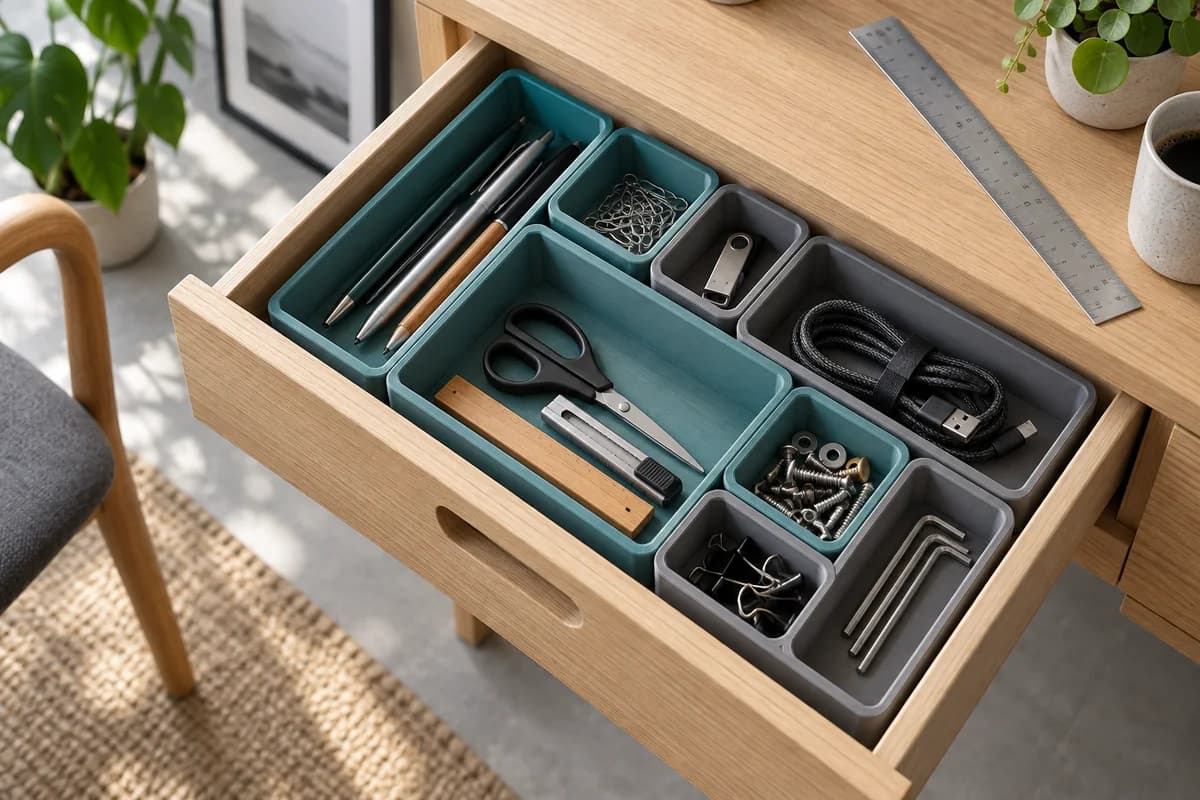
Short answer: a custom drawer organizer is a compartment tray printed to the exact inside dimensions of your drawer. In the free generator you enter width, depth and height, choose 1–8 columns and rows, wall thickness and extras (finger scoops, a label ledge, stacking), watch the 3D preview and send it to the quote. The default 120 × 90 × 30 mm PETG tray with six compartments comes to about €9.14 at current rates (65.8 g of material, 157 minutes of printing) – a worked example for that configuration, not a fixed price.
Why custom instead of off the shelf?
Store-bought inserts are made for an average drawer, so a strip stays empty at the sides and the dividers sit where you do not need them. A made-to-measure tray fills the drawer to the last millimetre: the pen slot is just narrow enough, the cable slot deep enough, and M3 and M4 screws get two separate cells. Because each tray is printed individually, you can order a single one for that gap in a desk no shop covers.
How do I measure the drawer?
- Measure the inside width and depth of the drawer and the height to the rim.
- Subtract 1–2 mm of clearance from each so the tray slides in without force.
- If the drawer is wider than 220 mm, split it into two or three trays that butt together – the largest footprint of one print is 220 × 220 mm.
- The values you enter are the tray’s outer dimensions.
Which settings are available?
| Setting | Range | When to use it |
|---|---|---|
| Outer size | up to 220 × 220 mm, up to 320 mm tall | drawer, desk, shelf, toolbox |
| Compartments | 1–8 columns × 1–8 rows, at least 12 × 12 mm and 6 mm deep | pens, cutlery, screws, batteries, cables |
| Walls, floor, dividers | independent thickness; stacking needs at least 3.6 mm | thinner for an office, thicker for a workshop |
| Finger scoops | on the long sides of compartments | picking up small parts |
| Label ledge | inside the front wall | labelling screws, bits, samples |
| Stacking | 1.6 mm rim on top, groove underneath, 0.25 mm clearance | several trays on top of each other |
| Floor holes | on/off | less material, drainage, lighter tray |
Which material?
PETG is the first choice: tough, does not crack when dropped, survives the heat in a car or garage. PLA is a little cheaper with the most colours – fine for an office or kitchen drawer. ASA for a balcony, a van or a sunny workshop. All three are in the generator’s catalogue; switching polymer reprices the tray immediately.
How much does a drawer organizer cost?
Designing and downloading the model is free. When you click “Get a print quote”, the model goes through the same BambuStudio slicer as any uploaded file: the price comes from material use and print time, the minimum is €4 per model, and no VAT is added. Printing takes 1–3 working days; EU shipping starts at €13.90 and pickup in Slovenia is free. Price grows mainly with wall height and the number of dividers, since both mean more material and time; a wide, low tray with few compartments is the cheapest per litre. Worked example: 120 × 90 × 30 mm, 2 × 3 compartments, PETG → about €9.14.
Are the trays Gridfinity-compatible?
No. These are made-to-measure trays with their own dimensions, not Gridfinity bins on a 42 mm grid. If you need Gridfinity, tell us – a separate mode is planned; until then you can upload a Gridfinity model from another source to the instant quote.
Frequently asked questions
How fast do I get the organizer?
Printing takes 1–3 working days; EU delivery adds 2–5 business days to neighbouring countries and typically 3–7 across the rest of the EU. Pickup in Gorica pri Slivnici, Slovenia, is free.
Can I order several identical trays?
Yes, set the quantity in the cart. Each extra tray adds only its own material and time; the base fee is charged once.
Can I download the model and print it at home?
Yes – STL, colour 3MF, OBJ, ZIP or OpenSCAD, free and without an account.
What if the trays do not stack precisely?
Stacking uses 0.25 mm of clearance, which suits most PETG and PLA filaments. Before a batch we print one sample pair and check it; a defective print is reprinted free of charge.
Sources
Dimensions, limits and the price example come from the generator documentation (docs/model-generators.md, verified 15 September 2026) and from a live BambuStudio slicer quote for the default PETG tray. Prices move with filament prices; the quote is what applies.