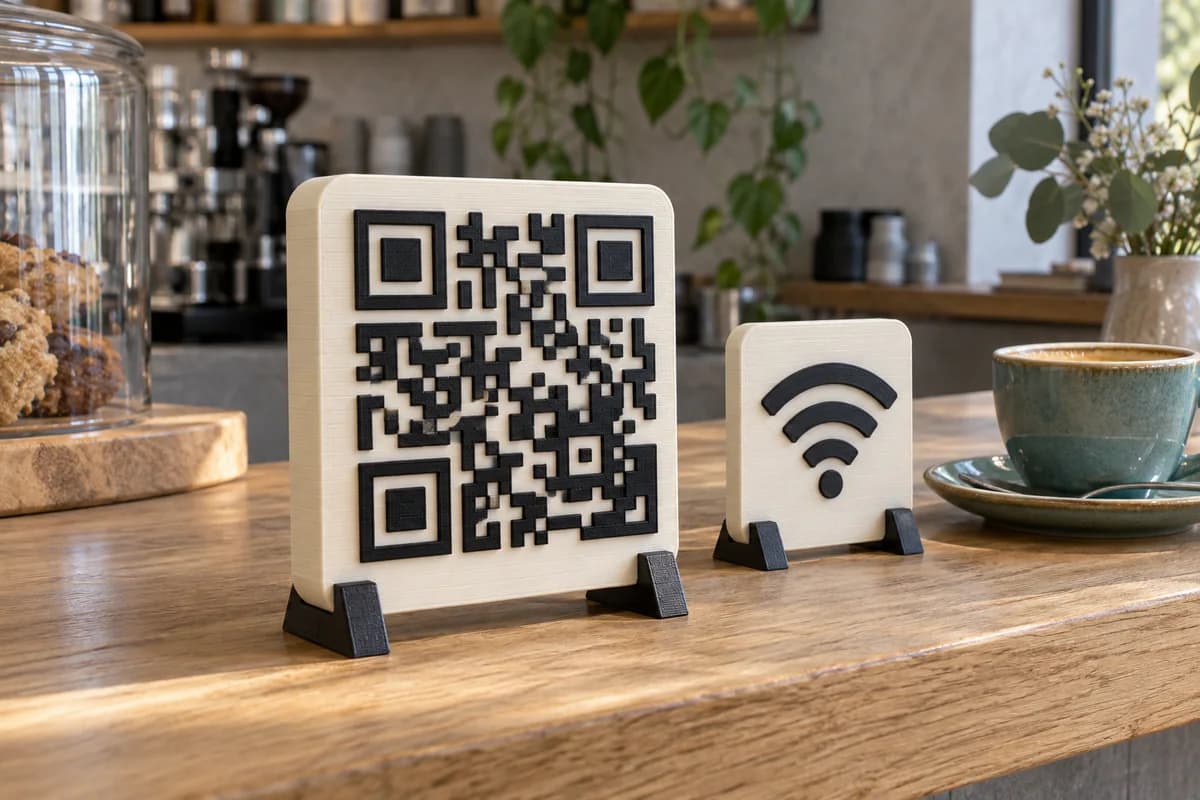
Short answer: a 3D printed QR code is a plastic tile whose modules are raised, or set in a second colour flush with the base, so a phone reads it like any printed code – no paper, no lamination, no peeling sticker. In the generator you enter a link, Wi-Fi network, text, email or phone number, pick two colours, a frame and a stand, verify the code in the flat preview and order the print. The price comes from material and time (minimum €4) and printing takes 1–3 working days.
Where does a printed QR code pay off?
| Use | Code content | Recommended build |
|---|---|---|
| Guest Wi-Fi, holiday flat, waiting room | SSID + password (hidden networks too) | two-colour tile with a “Wi-Fi” frame, 75° stand |
| Table menu or price list | link to the menu | 60–80 mm tile with stand, PETG for washing |
| Google reviews, bookings, web shop | link | counter or door tile with holes |
| Contact card, stall, workshop | phone or email with subject | smaller tile with keyring loop or hanging hole |
| Equipment label, shelf, box | text or link to instructions | flat two-colour code, no frame |
Why does a printed code work at all?
A phone looks for the three large finder squares, a quiet margin and contrast between modules. The generator therefore keeps every reserved cell, adds at least four quiet modules on each side and never makes a module narrower than 1.2 mm, which an FDM printer with a 0.4 mm nozzle renders cleanly. Colours are checked for contrast (at least 4.5 : 1, a light opaque base and darker modules); reflective, translucent and colour-changing filaments are excluded for QR because glare confuses the camera. You scan the preview before ordering anything; we scan the printed tile again before it ships.
Raised or flat code?
A raised code (modules 1–2 mm above the base) works even in one colour because shadows provide contrast, but strong side light makes it harder to read. A flat two-colour code is the most reliable: dark modules and a light base in the same plane, printed in one piece with a filament change. Flat codes are offered as 3MF and ZIP, not STL, because a single-colour STL would erase the code.
How do I set up a Wi-Fi code?
- Choose the Wi-Fi payload, enter the network name, password and security type (WPA is the usual one).
- Tick “hidden network” if the SSID is not broadcast.
- Add a frame labelled “Wi-Fi” or “Connect” and a stand if the tile sits on a table.
- Scan the code with your phone camera in the flat preview.
The password stays in your browser tab and in the generated file; it is never written to a URL or to analytics. Only the final 3MF is uploaded when you order.
How much does a printed QR sign cost?
Designing and downloading the model is free. When you click “Get a print quote”, the model goes through the same BambuStudio slicer as any uploaded file: the price comes from material use and print time, the minimum is €4 per model, and no VAT is added. Printing takes 1–3 working days; EU shipping starts at €13.90 and pickup in Slovenia is free. A 60 × 60 mm two-colour PLA tile usually lands in the single-digit euros; a stand and frame add a little. For several tables, set the quantity of the same tile in the cart; the base fee is charged once.
Frequently asked questions
Can I change the code later?
A static code carries its data itself; when the password or menu changes you print a new one. To change the destination without reprinting, encode a link to a page you control.
Which size is right?
60–80 mm for a table, 100–150 mm for a door or wall. Longer content (Wi-Fi with a long password) means more modules, so print it larger.
Does it work outdoors?
Yes, in ASA, which does not fade in the sun. Contrast holds up over months: a light base with dark modules stays readable.
Can I get an invoice for my business?
Yes, enter the company details in the cart; the invoice arrives by email.
Sources
Module, quiet-zone and contrast limits come from the generator documentation (docs/model-generators.md, 15 September 2026). Physical scanning still needs a printed sample, because geometric correctness does not measure surface finish.