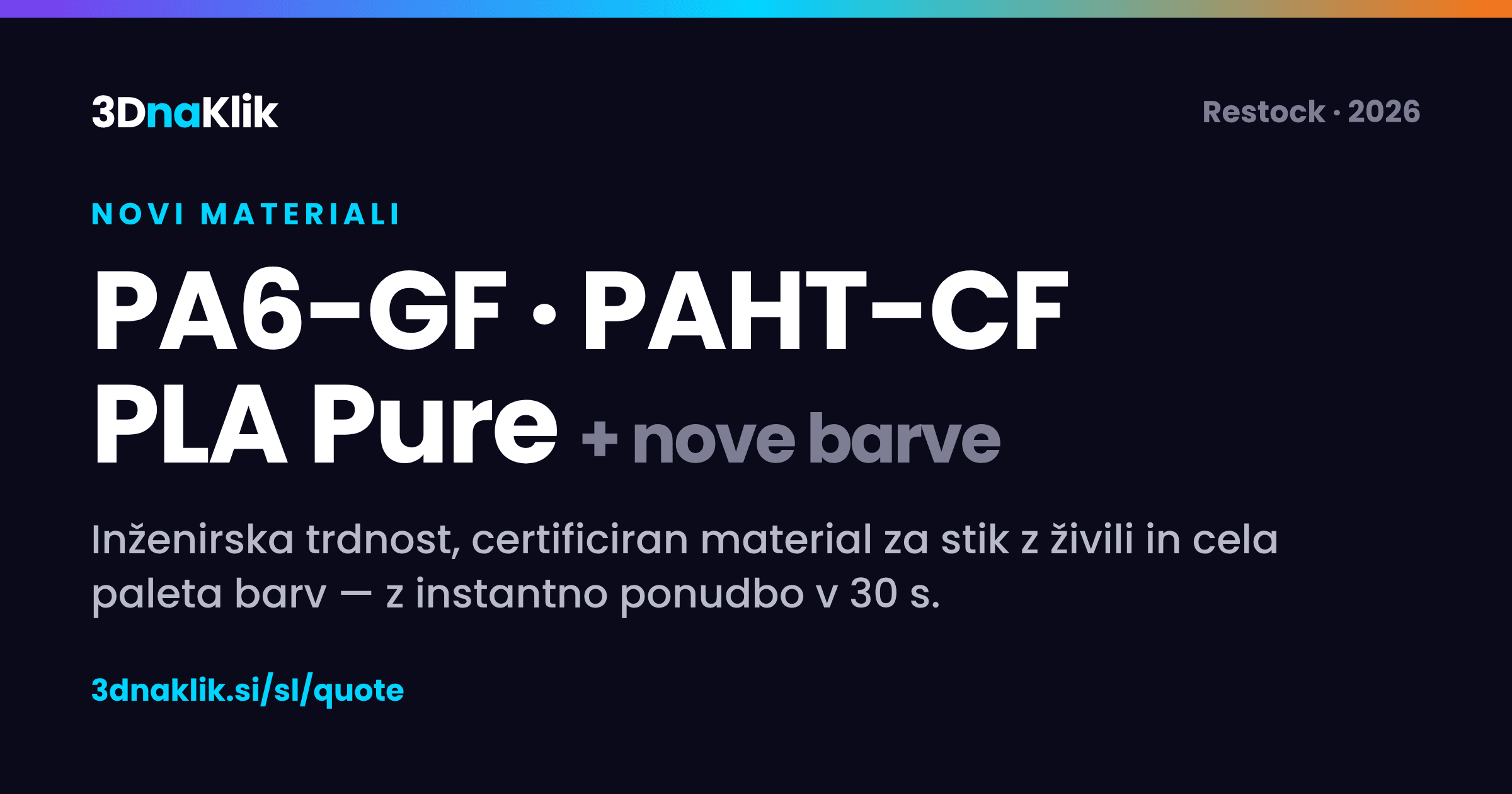
We have just restocked with our biggest materials shipment yet — and it includes two genuine engineering filaments for truly demanding parts, one material certified for food contact, and a whole palette of new colors and finishes. In this article we explain what each material can do, when to choose it, and what kinds of parts it suits. No marketing fluff, just concrete properties.
Everything below is available to order from 3DnaKlik today — upload your STL or 3MF file on the instant quote page and get a price for your chosen material in 30 seconds. We print on a Bambu Lab P2S in Gorica pri Slivnici, with delivery across Slovenia.
PA6-GF — nylon reinforced with glass fiber
PA6-GF is one of the strongest materials we can print. It is a nylon (polyamide 6) reinforced with glass fiber, which gives the material exceptional stiffness and mechanical strength. If you need a part that has to bear load and must not bend or crack, this is the right candidate.
Key properties:
- Exceptional strength and stiffness — significantly stiffer than PLA or PETG
- High temperature resistance — suitable for parts near heat sources
- Resistance to oils, chemicals, and wear — survives demanding environments
- Dimensional stability — minimal warping compared with plain nylon
What it is ideal for: brackets and mounts, mechanical and automotive parts, tools and accessories, jigs, and any load-bearing part. Because glass fiber is abrasive, we print it with a hardened tungsten-carbide nozzle — which is exactly why we upgraded our hardware in the same shipment.
PAHT-CF — nylon reinforced with carbon fiber
PAHT-CF is a high-temperature nylon reinforced with carbon fiber. It is lightweight yet exceptionally stiff — a combination valued in aerospace, robotics, and functional prototyping, anywhere every gram counts but the part still must not fail.
Key properties:
- Heat resistance up to 194 °C (heat deflection temperature under load) — holds up even in hot environments
- High stiffness at low weight — excellent strength-to-mass ratio
- Up to 50% lower moisture absorption than typical carbon-fiber nylons — stays dimensionally stable and retains its properties
- Reliability in demanding conditions — strong under both mechanical and thermal load
What it is ideal for: drone and RC parts, jigs and fixtures, functional prototypes, and parts near motors or other heat sources. Like PA6-GF, it is abrasive and we print it with a hardened nozzle.
Which material for your project — PETG, PA6-GF, or PAHT-CF
The most common mistake is printing everything in PLA. For functional parts that is almost never the right choice. Here is a quick overview of when to pick which material:
| Material | Main strength | Typical use |
| PETG | versatile, waterproof, affordable | everyday functional parts, enclosures, organizers |
| PA6-GF | maximum strength and stiffness | brackets, automotive and mechanical parts, tools |
| PAHT-CF | heat resistance + stiffness at low weight | drones, RC, jigs & fixtures, prototypes near heat |
Not sure what suits your case? Upload your file on /en/quote and select consulting in the notes — we will help you choose. You can also read more in our filament selection guide, and for spare parts see Replacement parts with 3D printing.
PLA Pure — a certified material for safer printing
PLA Pure is the cleanest PLA we have stocked. Bambu Lab designed it with the fewest additives and had it independently certified. It is important to understand what the certifications mean — and what they do not.
The material is verified against three international standards:
- EU 10/2011 — the regulation for materials and articles intended for food contact
- EN 71-3 — toy safety (EU Directive 2009/48/EC), limiting migration of heavy metals
- GREENGUARD UL 2904 — low emissions during printing, cleaner indoor air
It is made from just five ingredients from traceable sources, with no heavy metals, and is verified by migration testing (2 hours at 70 °C in food simulants). It is an excellent choice for toys, decoration, organizers, gifts, and anything that lives close to home and family. It is also available in a soft Milky Pink color.
An honest word about "food safe"
Here is the key point, stated plainly: a certified material does not automatically mean every printed object is food safe. FDM printing creates microscopic layers and crevices that can harbor bacteria, so practical limits apply:
- Not suitable for liquid foods (layers can leak and trap bacteria)
- Not for temperatures above 60 °C — so no dishwasher and no hot food
- For regular, direct food contact, the manufacturer recommends a dedicated nozzle to avoid cross-contamination with other materials
So we recommend PLA Pure mainly for dry items, toys, decoration, and gifts, where the cleanliness of the material and the low emissions matter — without risky promises. If you have a specific food-contact project, contact us before ordering and we will look at what makes sense together.
A whole palette of new colors and finishes
Engineering is not everything — printing is often about looks too. The same shipment brought more than ten new PLA and PETG shades:
- PLA Silk Multi-Color — a silky sheen that shifts between colors: Neon City, Dawn Radiance, Aurora Purple, and South Beach. Ideal for vases, decoration, and eye-catching prints.
- PLA Galaxy Purple — a sparkly, deep cosmic effect with flecks that glint in the light.
- PLA Metal Copper — a warm, metallic copper sheen for trophies and ornaments.
- PLA Wood (Birch and Ochre) — a natural wood look and feel for rustic projects.
- PLA Matte Scarlet Red — a velvety matte surface with no gloss that hides the layers.
- PLA Pure Milky Pink — a soft pastel from the certified Pure line.
- PLA Basic — the classics restocked: Black, Gray, and Jade White.
- PETG in five colors — Red, Yellow, Black, White, and Navy Blue: strong, waterproof, and slightly flexible for functional parts.
You choose the color during ordering — see the palette when you pick the material on the instant quote page or on the Materials page.
How to order a print in a new material
- Upload your STL or 3MF file on /en/quote
- Choose the material (e.g. PA6-GF, PAHT-CF, PLA Pure, or one of the new colors)
- Choose the print quality — for functional parts, Standard (0.20 mm) is usually an excellent choice
- Get an exact price including VAT in 30 seconds
- Confirm the order — we prepare and ship it, typically within 2 to 5 working days
The engineering materials (PA6-GF, PAHT-CF) are premium filaments, so their price is higher than PLA and PETG. The exact amount for your specific model is always shown instantly in the quote — no guessing, no registration required.
Frequently asked questions
How do PA6-GF and PAHT-CF differ? PA6-GF (glass fiber) focuses on maximum strength and stiffness under mechanical load. PAHT-CF (carbon fiber) offers top heat resistance (up to 194 °C) and stiffness at low weight, and absorbs less moisture. For load-bearing parts choose PA6-GF; for lightweight parts near heat choose PAHT-CF.
Is PLA Pure really food safe? The material is certified for food contact (EU 10/2011), but the printed object has limits: not for liquids, not above 60 °C, and a dedicated nozzle is recommended for regular food contact. It is best suited to toys, decoration, and gifts.
Can you print a large part from these materials? The maximum single-piece print size is 256 × 256 × 256 mm. Larger models can be split into parts and assembled after printing.
How much does a print in a new material cost? The price depends on size, material, and quality. Upload your file on the instant quote and get it in 30 seconds.
Ready to order?
The new materials are in stock today. Upload your STL or 3MF file, choose a material, and you will see an exact price in 30 seconds.
If you are not yet sure which material is right for your project, start with the filament selection guide, browse the full materials range, or contact us for advice.