3D scanning is the process of digitizing a physical object into an accurate 3D model on a computer using an optical device. The scanner captures the object's shape and dimensions as thousands of points in space, from which a digital copy is created. From it you can print the object, redesign it (reverse engineering) or produce any number of copies.
This guide is written in plain language, without unnecessary jargon, for anyone encountering 3D scanning for the first time: individuals, tradespeople, restorers, collectors and businesses. We explain what 3D scanning actually is, what it achieves, how it works step by step, and the difference between a plain scan (an STL mesh) and true reverse engineering (a parametric CAD STEP model). Importantly: you can mail the object to us from anywhere in Slovenia and we handle everything for you. We offer professional 3D scanning with fixed pricing (EUR 10/20/30).
What is 3D scanning (a simple explanation)
The easiest way to picture it: a 3D scanner works much like a camera, except it does not capture a flat image but the shape and true dimensions of an object in three dimensions. Instead of pixels it captures thousands of points in space and assembles them into an accurate spatial record of the object.
The raw output of scanning is a point cloud — a set of precisely measured points on the object's surface. Software connects these points into a mesh — a continuous surface made of thousands of small triangles. The mesh is then saved as an STL, OBJ or PLY file, which every 3D printing and modeling program can read.
What does this achieve? You get an accurate digital copy of a physical object that you can print, archive, measure or redesign. Scanning bridges the physical and digital worlds: the object you hold in your hand becomes a file that exists forever and can be reused at any time.
In Slovenian several terms exist for the same concept: 3D skeniranje (3D scanning), 3D digitalizacija (3D digitization) and zajem oblike (shape capture). They all mean the same thing — converting a real object into a digital 3D model.
How 3D scanning works (technologies)
There are three main ways to capture shape. Each has its strengths, and the difference directly affects how accurate your result will be.
- Structured light. The scanner projects a known pattern of light (a grid or stripes, often blue) onto the object, while cameras watch how the pattern bends across the surface. From this the software computes thousands of points at once. Fast and dense — ideal for small and medium objects with fine detail and crisp edges.
- Laser scanning. A laser line sweeps across the object; cameras read exactly where the laser hits the surface and compute distance by triangulation. It copes better with shiny and darker surfaces and larger objects, but a single pass captures less area, so a full scan can be slower.
- Photogrammetry. No special device — you take many ordinary photos from overlapping angles, and software reconstructs a 3D model from shared feature points. It captures color and texture beautifully but is less accurate and depends on lighting and surface texture. Suitable for rough and visual models, not precise functional parts.
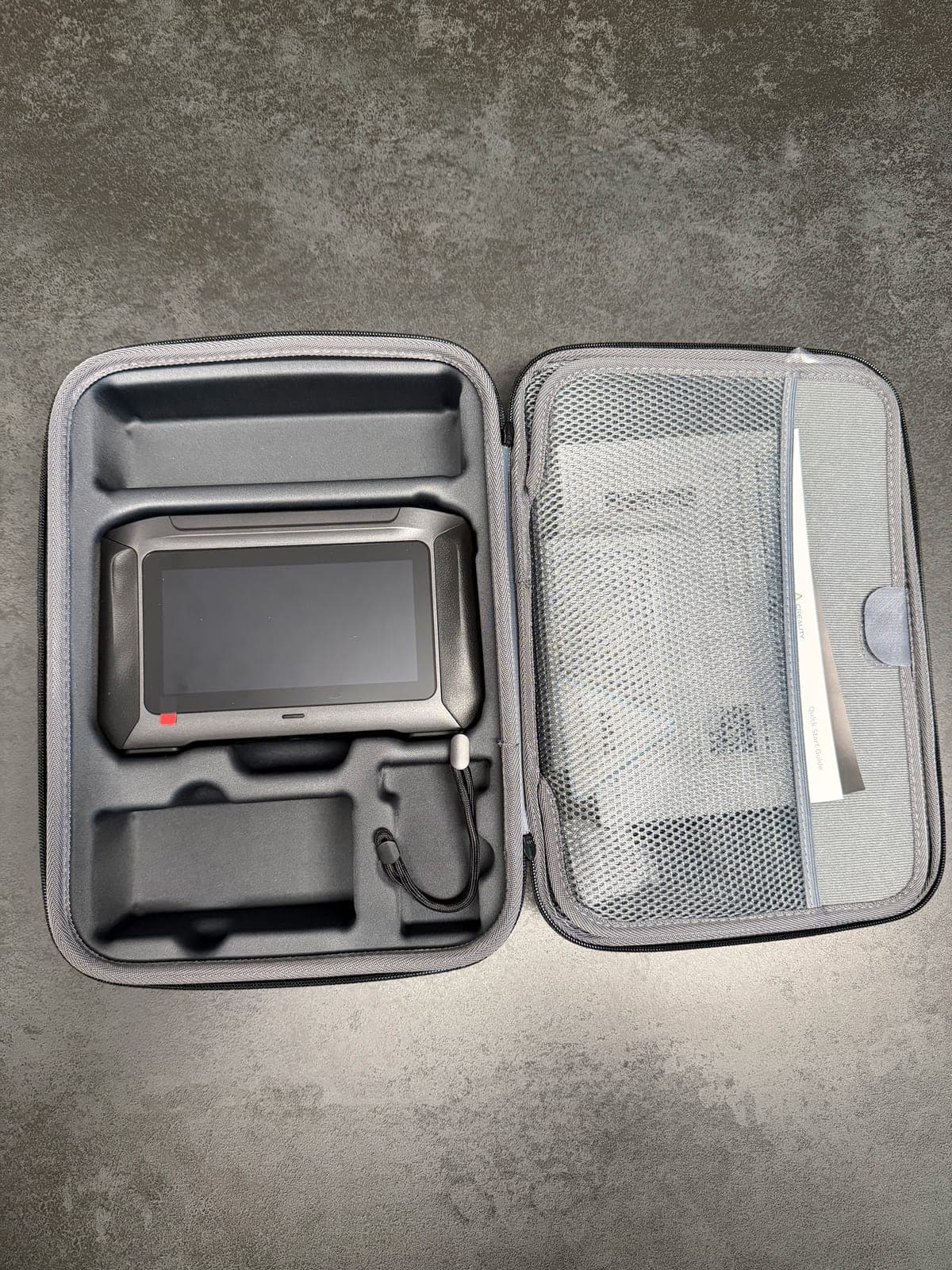
In practice, accuracy is key. Our Creality Sermoon P1 scanner (a combination of blue laser and infrared tracking) reaches accuracy down to 0.02 mm — thinner than a sheet of paper and finer than the human eye can see. For a part that must actually fit, that accuracy is a precondition; phone photogrammetry is only good enough for rough, visual models.
One more practical detail that shows experience: shiny, transparent and very dark (black) surfaces scatter or absorb light and scan poorly. So before scanning we lightly apply a matte, traceable, removable spray — this is part of normal preparation and greatly improves the result.
The process step by step — from object to digital model
No technical knowledge is required from you. The process looks like this:
- 1. You send the physical object. You mail it from anywhere in Slovenia to our address in Gorica pri Slivnici, or drop it off in person. Add a short note whether you want only the mesh (STL) or also reverse engineering (CAD).
- 2. We scan the object. If needed we prepare the surface (matte spray) and capture the object from multiple angles to cover the full geometry.
- 3. We align and clean the captures. We register (align) the individual captures into one point cloud, convert it into a watertight mesh (STL), close any holes and remove noise.
- 4. We build a CAD model if requested. From the mesh we can build a tidy, editable CAD model (STEP) with true dimensions — this is reverse engineering.
- 5. We print or deliver the files. We can print the object immediately — choosing FDM or resin depending on whether you need a sturdy functional part or a fine detailed copy — or hand over the files for you to keep. Once an object is digitized, you can reproduce it in unlimited quantity.
Because objects are sent by post, the service is available across all of Slovenia — you do not need to travel to us. Typical turnaround is around 3 days from receiving the object, and we deliver files in the agreed format (STL/OBJ/PLY, printable 3MF, STEP on request). Find the details on the 3D scanning page.
Reverse engineering — from scan to CAD (STL vs STEP)
This is the decision that most affects what you can do with the model. Here it is, jargon-free.
STL mesh — print the object as it is
A raw scan is a mesh of thousands of triangles (STL, OBJ or PLY). It describes the object's shape accurately and is perfect when you want to print or copy the object as it is. It is not suitable for editing dimensions, though: you cannot easily change a single hole diameter or wall thickness in a mesh.
Parametric CAD STEP — edit dimensions and design
In reverse engineering we rebuild a tidy, parametric CAD model from the scanned mesh, with smooth faces and true dimensions. The result is a STEP file you can open in any serious CAD program to change dimensions, add holes, reinforce ribs or improve the design. In Slovenian this concept is expressed by the terms obratno inženirstvo, vzvratno inženirstvo and povratno inženirstvo (reverse engineering) — all meaning the same.
Honest about the limits: the scanner captures the object exactly as it is right now. If a part is worn, deformed, cracked or missing a piece, the scan will faithfully reproduce that flaw. In reverse engineering we can correct some flaws with engineering judgement — restore symmetry, reconstruct a missing section from the intact side, or re-true the dimensions. But a perfectly accurate reconstruction of a badly damaged part is not always possible; it is important you know this in advance. More about the service on the reverse engineering page.
What 3D scanning is used for (real examples)
The biggest benefit of 3D scanning is reproducing parts you can no longer buy: scan once, print unlimited copies — and even improve them (thicker walls, reinforced ribs, adapted mounts). The most common areas of use:
| Area | Typical examples |
| Machines and industry | worn gears, guards, pulleys, bushings, jigs and tool holders |
| ATV / quad and motorcycles | broken fairing tabs, switch housings, mirror and fender brackets, dashboard parts |
| Agricultural machinery | spacers, bushings, covers, shields, knobs and handles for older tractors |
| Classic cars and vehicles | trim clips, emblem backings, dashboard knobs, vent louvers |
| Household appliances | door handles, shelf supports and rails, knobs, gears and mixer couplers |
| Restoration and collecting | reproduction of figurines and reliefs, heirloom backups, symmetrical rebuilds of damaged parts |
Material choice depends on where the part will live. For functional parts we recommend PETG (versatile, tough, moisture-resistant), and for parts exposed to sun and weather, ASA (UV- and heat-resistant, won't go brittle outdoors). ABS tolerates higher temperatures, while PLA is best kept for indoor, non-stressed and decorative pieces. The full selection and properties are on the materials page, where you choose from 14 materials.
That this is not theory is proven by many classic-vehicle restorations, where missing plastic parts (e.g. in oldtimer restorations) were recreated precisely by scanning a surviving — sometimes even cracked — original. Often this is the only route to a part that nobody makes anymore.
3D scanning and 3D printing — how they connect
This is our real advantage: after scanning, the model can go straight to printing in 14 materials. Simply upload the finished model to our system and in about 30 seconds you get an instant print quote — no waiting for an email offer.
Maximum print size is 256 × 256 × 256 mm; larger objects are split into parts by arrangement, or delivered to you as files only for printing elsewhere. Also important: we partially credit the scanning fee toward your print order, so the scan is not a double cost if you go on to print with us. This way the whole journey — from a physical object to a printed replacement part — happens under one roof.
How much does 3D scanning cost? (in brief)
Pricing is simple and fixed: €10, €20 or from €30 (reverse engineering). All are final consumer prices — VAT is not added on top — and are charged per item, not per hour. A smaller object is scanned for €10, a medium one for €20, and complex objects and CAD reverse engineering from €30.
Since this is a guide about what 3D scanning is, we deliberately leave the details elsewhere. You will find the itemized pricing, what affects the price, and a comparison with hourly shops in a separate guide: how much 3D scanning costs.
Frequently asked questions (FAQ)
What is 3D scanning and what does it produce?
3D scanning is the process of digitizing a physical object into an accurate 3D model using an optical device. The raw result is a point cloud, which we process into a mesh (an STL, OBJ or PLY file). You can print, archive or measure this model, or build a CAD model from it for reverse engineering.
How does 3D scanning work?
A scanner using structured light, laser or photogrammetry captures the object's shape from multiple angles. Software aligns the captures and connects them into a triangle mesh. We use the Creality Sermoon P1 scanner with accuracy down to 0.02 mm, which is essential for parts that must fit.
What is the difference between 3D scanning and reverse engineering?
3D scanning produces a mesh (STL) — an accurate surface of the object, ideal for printing a copy as it is. Reverse engineering goes a step further: from the scan we build a tidy parametric CAD model (STEP) with true dimensions that you can edit — dimensions, holes and design improvements.
Can you scan and print a replacement part that can no longer be bought?
Yes, this is one of the most common uses. We scan the existing or damaged part, repair the geometry with reverse engineering if needed, and print it in a suitable material — most often PETG, ABS or ASA for functional parts. The condition is at least one whole piece or enough references for a reliable reconstruction.
Can I scan the object myself with a phone?
For rough models and visualization, yes; for accurate replacement parts, we do not recommend it. Phone photogrammetry struggles to capture fine details, true dimensions and shiny surfaces. For a part that must actually fit, or for CAD reverse engineering, a high-accuracy professional scan is almost essential.
How do I send you the object and how long does the process take?
You mail the object from anywhere in Slovenia to our address in Gorica pri Slivnici, or drop it off in person. Typical turnaround is around 3 days from receiving the object. You get the files in the agreed format (STL/OBJ/PLY, printable 3MF, STEP on request), after which we can print the object immediately.
Summary
3D scanning is a digital copy of a physical object: the scanner captures its shape and dimensions into an accurate 3D model. From it you can print the object, redesign it with reverse engineering into a tidy CAD model (STEP), and reproduce it in unlimited quantity — even improved. You mail the object to us from anywhere in Slovenia, and we scan it and, if you wish, print it immediately.
Next step: discover our 3D scanning service, compare prices in the guide how much 3D scanning costs, or calculate a print price in 30 seconds.