3D scanning with us costs €10, €20 or from €30 — these are final consumer prices with no VAT added on top. A small object up to about 10 cm is scanned for €10, an object up to about 25 cm for €20, and complex objects or reverse engineering into CAD for from €30. Basic model cleanup is included in the price. See a detailed breakdown of the packages and the current 3D scanning price list on our service page.
This guide is for anyone who needs an accurate digital copy of a physical object: individuals who want to print a spare part, small businesses and trades needing prototypes and tooling aids, restorers and collectors, and anyone looking for a replacement part that can no longer be bought. Below we explain how much 3D scanning costs, what affects the price, how the process works, and the difference between a plain scan (an STL mesh) and reverse engineering (a parametric CAD STEP model).
How much does 3D scanning cost?
Pricing is simple and transparent. We split it into three tiers based on the size and complexity of the object. All prices listed are final consumer prices — VAT is not added on top.
| Package | Object size | What you get | Price (final) |
| Mini | up to ~10 cm | STL/OBJ/PLY mesh with basic cleanup | €10 |
| Standard | up to ~25 cm | STL/OBJ/PLY mesh with basic cleanup | €20 |
| Pro / RE | complex or reverse engineering | Mesh + parametric CAD model (STEP) | from €30 |
Worked example: a metal bracket 8 cm long falls into the Mini tier, so scanning costs €10. For that price you get a cleaned mesh in STL format that you can send straight to print. If you wanted a tidy, dimensionally correct CAD model (STEP) from the same bracket — one where you can change holes, wall thicknesses or improve the design — that is reverse engineering work in the Pro/RE tier from €30.
Why are we cheaper than hourly shops?
At most Slovenian providers, 3D scanning starts at around €50 + VAT, or is billed at roughly €50/hour + VAT, often as a "quote on request" where you do not know the final price in advance. That is unpredictable for the customer: with hourly billing you cannot estimate the cost until the work is done. Our approach is the opposite — a fixed, transparent, final amount based on object size. For most objects our price is significantly lower, and above all you know in advance what you will pay.
What affects the price
The cost of 3D scanning depends on three main drivers. Once you understand them, you can estimate fairly well which tier your object falls into.
- Object size. A larger object needs more captures and more time to align the scan. That is why we separate tiers up to ~10 cm, up to ~25 cm, and larger or complex objects.
- Geometry complexity. Smooth, regular shapes (cylinders, flat faces, simple housings) are quick. Deep grooves, fine textures, internal cavities and thin ribs require more care and more mesh post-processing.
- Mesh only (STL) vs parametric CAD (STEP). A raw scan is a triangle mesh. If you need a tidy, editable CAD model with dimensions (STEP), that is additional engineering work in the Pro/RE tier.
Two practical tips. First, shiny, transparent and very dark (black) surfaces are harder for optical scanning to capture. In those cases we lightly apply a matte spray (traceable, removable) before scanning, which greatly improves the result. Second, if you need to scan a batch of identical or similar objects, the per-unit price is lower — tell us the quantity and we will prepare a combined quote.
How 3D scanning works (step by step)
The process is simple and requires no technical knowledge on your part.
- 1. Prepare and send the object. Wipe off dust and grease. You mail the object from anywhere in Slovenia to our address in Gorica pri Slivnici, or drop it off in person. Add a short note whether you want only the mesh (STL) or also reverse engineering (STEP).
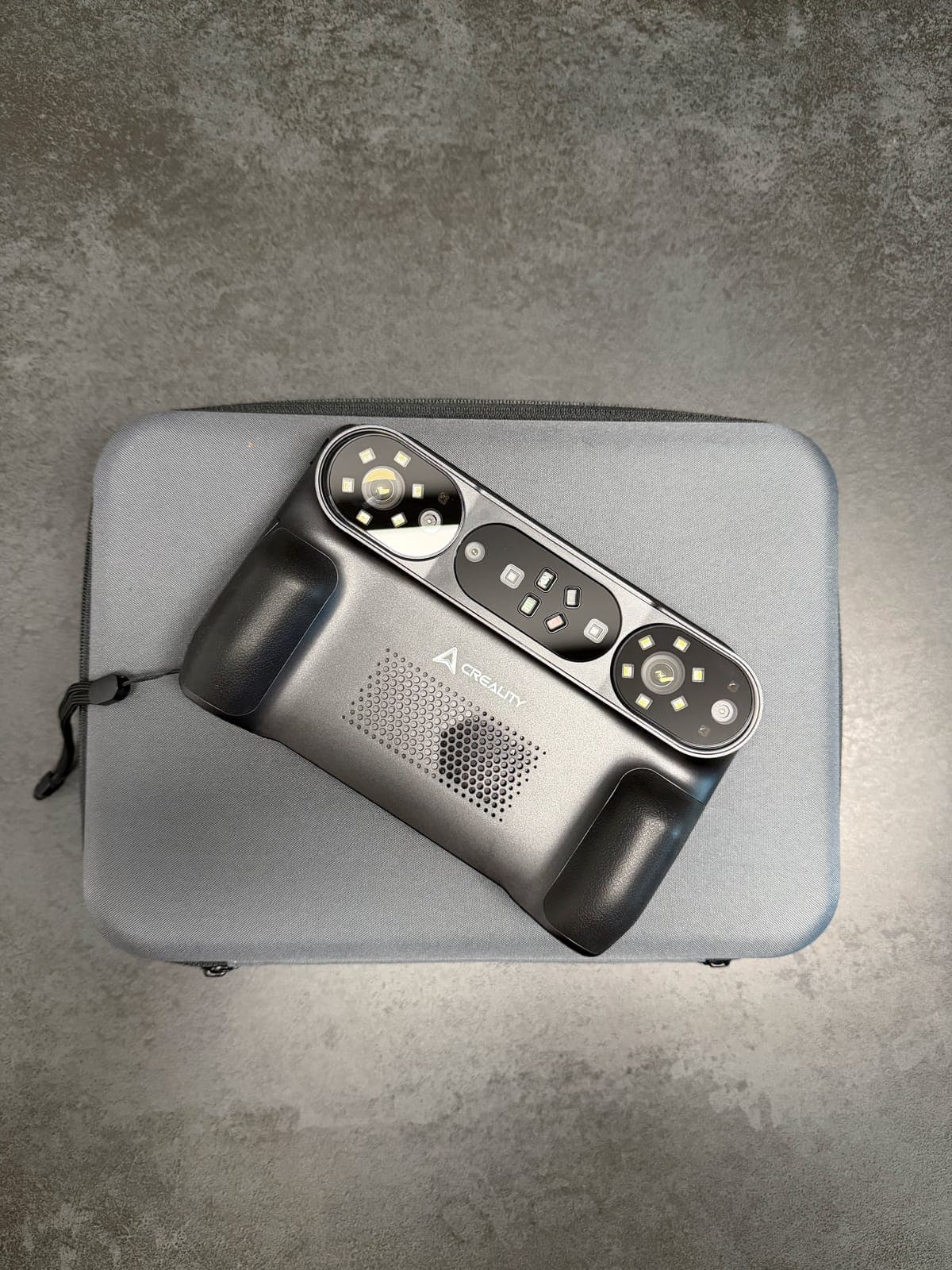
- 2. Scanning. We scan the object with a professional 3D scanner, the Creality Sermoon P1, with accuracy down to 0.02 mm. We capture the full geometry from multiple angles.
- 3. Model processing. We align the captures, close any holes and clean up the model. For the Pro/RE package we additionally rebuild a parametric CAD model from the mesh.
- 4. File delivery. We deliver the files in the agreed format (STL/OBJ/PLY, printable 3MF, STEP on request). Typical turnaround is around 3 days from receiving the object.
Because objects are sent by post, our service is available across all of Slovenia — you do not need to travel to us. Learn more on the 3D scanning page.
3D scanning vs reverse engineering: STL or CAD?
This is the most important decision; it affects both the price and what you can do with the model. Here it is, jargon-free.
STL mesh (a plain scan)
The raw output of 3D scanning is a mesh — a surface made of thousands of small triangles, stored as STL, OBJ or PLY. The mesh describes the object's shape accurately and is perfect when you want to print the object as it is or make a copy. It is not suitable for editing dimensions, though: you cannot easily change a single groove or hole diameter in a mesh.
Parametric CAD STEP (reverse engineering)
In reverse engineering we rebuild an editable, parametric CAD model from the scanned mesh, with smooth faces, true dimensions and geometry that can be changed. The result is a STEP file you can open in any serious CAD program to change dimensions, add holes or improve the design. This is genuine reverse engineering — in Slovenian the same concept is expressed by the terms obratno inženirstvo, vzvratno inženirstvo and povratno inženirstvo. Read more on the reverse engineering page.
Honest about the limits: a 3D scanner accurately captures the object exactly as it is right now. If a part is worn, deformed, cracked or missing a piece, the scan will faithfully reproduce that flaw. In reverse engineering we can correct some of these (restore symmetry, reconstruct a missing section from a reference), but expect this to be a matter of engineering judgement and agreement — a perfectly accurate reconstruction of a badly damaged part is not always possible.
3D scanning for spare and replacement parts
This is where 3D scanning pays off most. When a part can no longer be bought — the manufacturer no longer makes it, the model is obsolete, or the part has been replaced by a more expensive assembly — scanning and printing is often the only sensible route. Typical examples:
- Household appliances — broken buttons, gears, shelf supports, caps and clips.
- Cars and classic cars — clips, trims, brackets, dashboard knobs and plastic parts no longer on sale.
- Agricultural machinery — spacers, covers, housings and brackets, where fast availability matters more than the original material.
- Retro electronics and collectibles — buttons, casings, feet and parts of old devices.
- Furniture fittings — corner brackets, guides, clips and spacers.
For functional replacement parts we recommend tougher materials. PETG is a good all-rounder (tough, moisture-resistant), while ABS and ASA tolerate higher temperatures and (ASA) outdoor UV exposure. The full selection and properties are on the materials page, where you choose from 14 materials.
Can I scan the object myself? (phone vs professional scanner)
You can try, but let's be honest about the differences. With photogrammetry apps on a phone you can capture the rough shape of a larger object — enough for visualization, a game or a very rough model. Problems arise with accuracy and small details: a phone struggles to capture fine edges, thin walls, true dimensions and shiny surfaces, and the result often contains noise and distorted dimensions.
Our professional Creality Sermoon P1 scanner reaches accuracy down to 0.02 mm, a class a phone cannot match. For replacement parts that actually have to fit, or for CAD reverse engineering, that accuracy is a precondition for a usable result. The rule is simple: for fun and rough models a phone is enough; for a working part that must fit, a professional scan is worth it.
From scan to printed part
This is our real advantage. After scanning we can print the object immediately in 14 materials. Simply upload the finished model to our system and in about 30 seconds you get an instant print quote — no waiting for an email offer. Maximum print size is 256 × 256 × 256 mm; larger objects are split into parts by arrangement or delivered to you as files only for printing elsewhere.
Even better: we partially credit the scanning fee toward your print order, so the scan is not a double cost if you go on to print with us. If you are comparing scanning and printing costs, see the pricing page too.
Next step: explore our 3D scanning service or calculate a print price right away.
Frequently asked questions
How much does it cost to 3D scan an object?
With us, €10, €20 or from €30. An object up to about 10 cm is scanned for €10, up to about 25 cm for €20, and complex objects or reverse engineering into CAD for from €30. All are final prices with no VAT added on top, and basic model cleanup is included.
Is the price per hour or per item?
Per item. You pay a fixed, known-in-advance amount based on the size and complexity of the object, not per hour. So you know what you will pay before you even send it in. This differs from hourly billing (e.g. ~€50/hour + VAT), which is common at many providers.
What is the difference between 3D scanning and reverse engineering?
3D scanning produces a mesh (STL/OBJ/PLY) — an accurate surface of the object, ideal for printing a copy as it is. Reverse engineering goes a step further: from the scan we build a tidy parametric CAD model (STEP) with true dimensions that you can edit (dimensions, holes, improvements). Reverse engineering therefore falls into the Pro/RE tier from €30.
Can you scan and print a replacement part that can no longer be bought?
Yes, this is one of our most common services. We scan the existing (or damaged) part, repair the geometry with reverse engineering if needed, and print it in a suitable material — most often PETG, ABS or ASA for functional parts. The condition is that at least one whole piece, or enough references, exists so we can reliably reconstruct the shape.
Can I scan the object myself with a phone?
For rough models and visualization, yes; for accurate replacement parts, we do not recommend it. Phone photogrammetry struggles to capture fine details, true dimensions and shiny surfaces. Our scanner reaches accuracy down to 0.02 mm, which is often essential for parts that must fit or for CAD reverse engineering.
How do I send you the object and how fast is it done?
You mail the object from anywhere in Slovenia to our address in Gorica pri Slivnici, or drop it off in person. Typical turnaround is around 3 days from receiving the object. You receive the files in the agreed format (STL/OBJ/PLY, printable 3MF, STEP CAD on request).
Summary
3D scanning with us costs €10, €20 or from €30 — final prices with no VAT added on top, with basic model cleanup included. You pay per item, not per hour, and you know in advance what you will pay. We scan with accuracy down to 0.02 mm, you mail the object from anywhere in Slovenia, and files are ready in about 3 days. For spare parts, prototypes and reverse engineering this is a fast and price-predictable route — especially because the scan can be followed by printing in 14 materials, with the scanning fee partially credited toward your order.
Start now: discover our 3D scanning service or calculate a print price in 30 seconds.